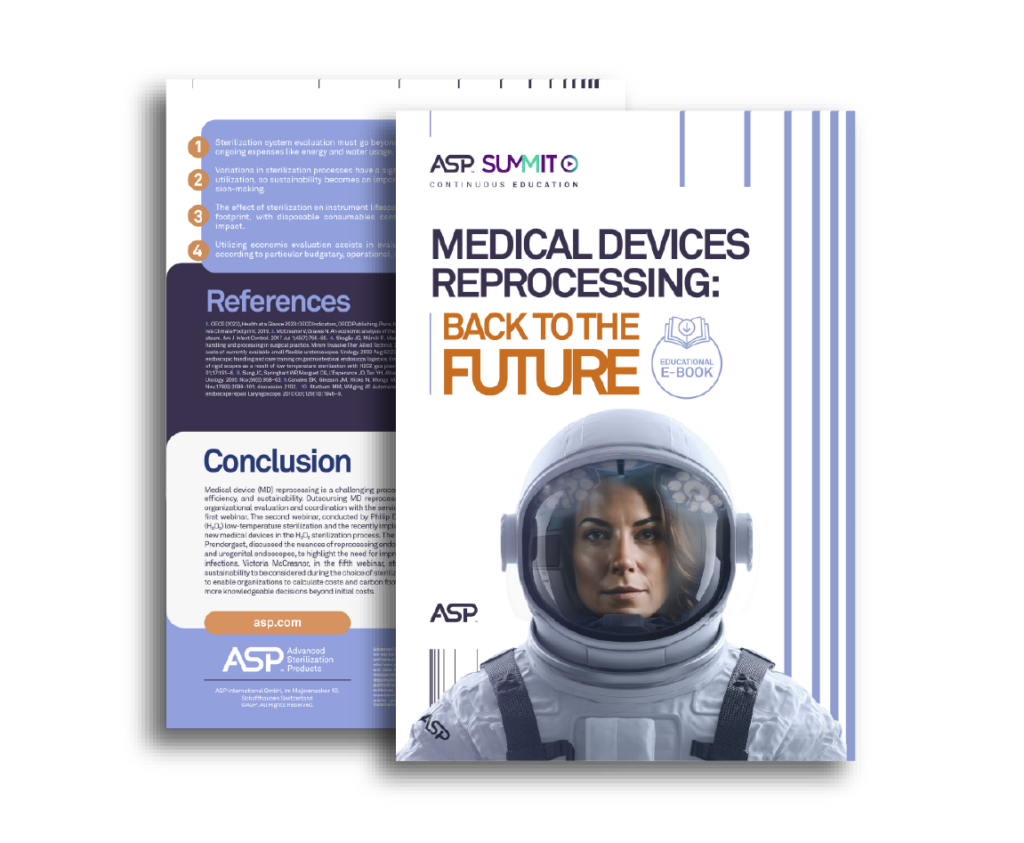
Medical Devices Reprocessing: Back to the future
Create a free account to access all information→Healthcare is a major contributor to the climate crisis: many countries spend close to 10% of GDP on health care without a guaranteed improvement in outcomes,¹ and the sector accounts for roughly 4.4% of global net emissions, ranging from 5.1% in Australia to 7.6% in the USA.² Embedding sustainability into technology appraisals, via life-cycle assessment across raw material extraction, manufacturing, use, and disposal, is essential to reducing this footprint.
Choosing between steam and low-temperature sterilization carries real economic weight: switching to low-temperature systems has been shown to cut rigid-endoscope repairs by up to 33% and procedure-related repairs by 58%,³,⁴ since steam accelerates wear on plastics, corrosion-prone alloys, and electrical components. Across seven independent studies of flexible ureteroscopes, cystoscopes, and endoscopes, the average repair cost reached $3,749, highlighting the scale of savings achievable by reducing instrument damage.⁴⁻¹⁰
Together, these findings argue for economic evaluation—not just upfront price—when selecting sterilization systems, balancing cost, effectiveness, and environmental impact.
Inside the eBook, you’ll learn about:
- The key considerations, advantages, and challenges of outsourcing MD reprocessing services
- The new ISO 22441 standard for hydrogen peroxide (H₂O₂) low-temperature sterilization and what it means for manufacturers and healthcare facilities
- Infection risks and reprocessing strategies for airway devices, including bronchoscopes, laryngoscopes, and nasal scopes
- The evolution of urogenital endoscope decontamination and the ongoing debate around the Spaulding classification
- Sustainability and economic evaluation frameworks for choosing between steam and low-temperature sterilization systems
Reasons to download the eBook
- Get practical guidance for evaluating and planning MD reprocessing outsourcing options
- Understand the implications of the new ISO 22441 standard for your sterilization processes
- Learn about infection risks specific to airway and urogenital device reprocessing, and how to mitigate them
- Access data-driven comparisons of cost, repair rates, and carbon footprint across sterilization technologies
- Get consolidated takeaways from five expert-led ASP webinars in a single resource
Authors







Related eBooks

References
- OECD (2023), Health at a Glance 2023: OECD Indicators, OECD Publishing, Paris. https://doi.org/10.1787/7a7afb35-en
- Health Care Without Harm, ARUP. Healthcare’s Climate Footprint. 2019.
- McCreanor, V., & Graves, N. (2017). An economic analysis of the benefits of sterilizing medical instruments in low-temperature systems instead of steam. Am J Infect Control, 45(7), 756–760.
- Skogås, J.G., & Mårvik, R. (2003). Measures taken to reduce damage and repair costs of rigid endoscopes during their handling and processing in surgical practice. Minim Invasive Ther Allied Technol, 12(1), 76–81.
- Landman, J., Lee, D.I., Lee, C., & Monga, M. (2003). Evaluation of overall costs of currently available small flexible ureteroscopes. Urology, 62(2), 218–222.
- Mahawongkajit, P., Techagumpuch, A., & Auksornchat, K. (2022). Effects of basic endoscopic handling and care training on gastrointestinal endoscopy logistics. Endosc Int Open, 10(1), E56–e61.
- Schäfer, B. (2009). Decreased number of repairs of rigid scopes as a result of low-temperature sterilization with H₂O₂ gas plasma: A field report from the Barmherzige Brüder Hospital in Trier, Germany. 17, 191–196.
- Sung, J.C., Springhart, W.P., Marguet, C.G., L’Esperance, J.O., Tan, Y.H., Albala, D.M., et al. (2005). Location and etiology of flexible and semirigid ureteroscope damage. Urology, 66(5), 958–963.
- Canales, B.K., Gleason, J.M., Hicks, N., & Monga, M. (2007). An independent analysis of flexible cystoscope repairs and cost. J Urol, 178(5), 2098–2101.
- Statham, M.M., & Willging, J.P. (2010). Automated high-level disinfection of nonchanneled flexible endoscopes: duty cycles and endoscope repair. Laryngoscope, 120(10), 1946–1949.