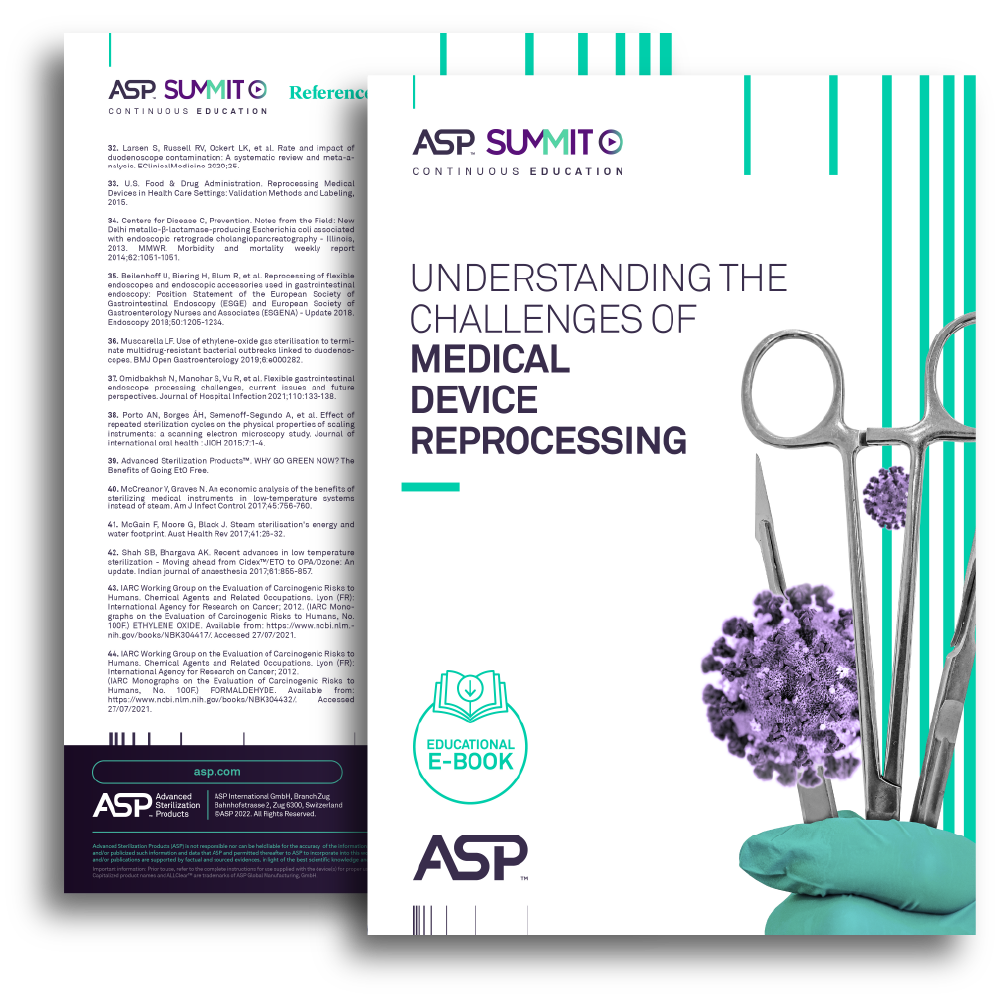
Understanding the Challenges of Medical Device Reprocessing
Create a free account to access all information→Healthcare-associated infections (HAI) remain the most common adverse event in care delivery,¹ affecting an estimated 3.7 million patients in Europe each year, with surgical site infections (SSI) accounting for 18.3% of cases.² **SSI alone adds thousands of euros in costs and extra hospital days per patient.**³
Effective device decontamination — spanning cleaning, disinfection, packaging, and sterilization — is essential to prevention, yet each stage carries risk of error.⁴ The decades-old Spaulding classification struggles with today’s complex devices;⁵ robotic instruments, with multiple articulation points and channels that resist disassembly, are especially difficult to clean, leaving residual bioburden that raises infection risk.⁶
High-level disinfection (HLD) … has proven insufficient: a meta-analysis of over 13,000 samples found 16.14% of “patient-ready” duodenoscopes remained contaminated after HLD alone,⁷ driving a shift toward sterilization as the new benchmark for endoscope reprocessing.⁸ Yet high-temperature steam sterilization can degrade heat-sensitive instruments, with one facility projected to spend over $1 million on avoidable repairs over a decade.⁹ Ethylene oxide and formaldehyde gas carry their own risks, both classified as carcinogenic to humans.¹⁰
Hydrogen peroxide gas plasma sterilization addresses these gaps, delivering significantly lower failure rates than vaporized hydrogen peroxide sterilization¹¹ with rapid, residue-free, low-emission processing for heat-sensitive devices.¹²
Inside the eBook, you’ll learn about:
- The scale and clinical/financial cost of healthcare-associated and surgical site infections
- Why the 50-year-old Spaulding classification may fall short for modern, complex medical devices
- Reprocessing challenges specific to robotic and minimally invasive surgical instruments
- Why high-level disinfection is increasingly insufficient to prevent endoscope-related outbreaks
- The risks and trade-offs of steam, ethylene oxide, formaldehyde, and low-temperature sterilization methods
- The shared responsibility of device manufacturers, sterilizer manufacturers, and healthcare professionals in instrument validation
- How hydrogen peroxide gas plasma sterilization addresses these unmet reprocessing needs
Reasons to download the eBook
- Understand the true clinical and financial cost of inadequate medical device reprocessing
- Learn why legacy classification systems may no longer fit today’s complex instruments
- Access data-backed comparisons of sterilization methods on safety, cost, and environmental impact
- Review real-world outbreak case studies tied to reprocessing failures
- Discover how hydrogen peroxide gas plasma sterilization can reduce infection risk and long-term costs
Authors






Related eBooks

References
- Global guidelines for the prevention of surgical site infection, second edition. Geneva: World Health Organization; 2018.
- Suetens, C., Latour, K., Kärki, T., et al. Prevalence of healthcare-associated infections, estimated incidence and composite antimicrobial resistance index in acute care hospitals and long-term care facilities: results from two European point prevalence surveys, 2016 to 2017. Euro Surveill, 2018;23.
- Badia, J.M., Casey, A.L., Petrosillo, N., et al. Impact of surgical site infection on healthcare costs and patient outcomes: a systematic review in six European countries. J Hosp Infect, 2017;96:1–15.
- Decontamination and reprocessing of medical devices for health-care facilities. Geneva: World Health Organization; 2016.
- Rutala, W.A., & Weber, D.J. Disinfection and sterilization: an overview. Am J Infect Control, 2013;41:S2–5.
- Healthcare Purchasing News. Managing the Reprocessing Challenges of Robotic Instruments. Accessed 19/08/2021.
- Larsen, S., Russell, R.V., Ockert, L.K., et al. Rate and impact of duodenoscope contamination: A systematic review and meta-analysis. EClinicalMedicine, 2020;25.
- U.S. Food & Drug Administration. Reprocessing Medical Devices in Health Care Settings: Validation Methods and Labeling. 2015.
- McCreanor, V., & Graves, N. An economic analysis of the benefits of sterilizing medical instruments in low-temperature systems instead of steam. Am J Infect Control, 2017;45:756–760.
- IARC Working Group on the Evaluation of Carcinogenic Risks to Humans. Agents classified by the IARC Monographs, Volumes 1–129.
- Rutala, W.A., Gergen, M.F., Sickbert-Bennett, E.E., et al. Comparative evaluation of the microbicidal activity of low-temperature sterilization technologies to steam sterilization. Infect Control Hosp Epidemiol, 2020;41:391–395.
- Advanced Sterilization Products. STERRAD™ 100NX Sterilization System with ALLClear™ Technology User’s Guide. A11150401-50.