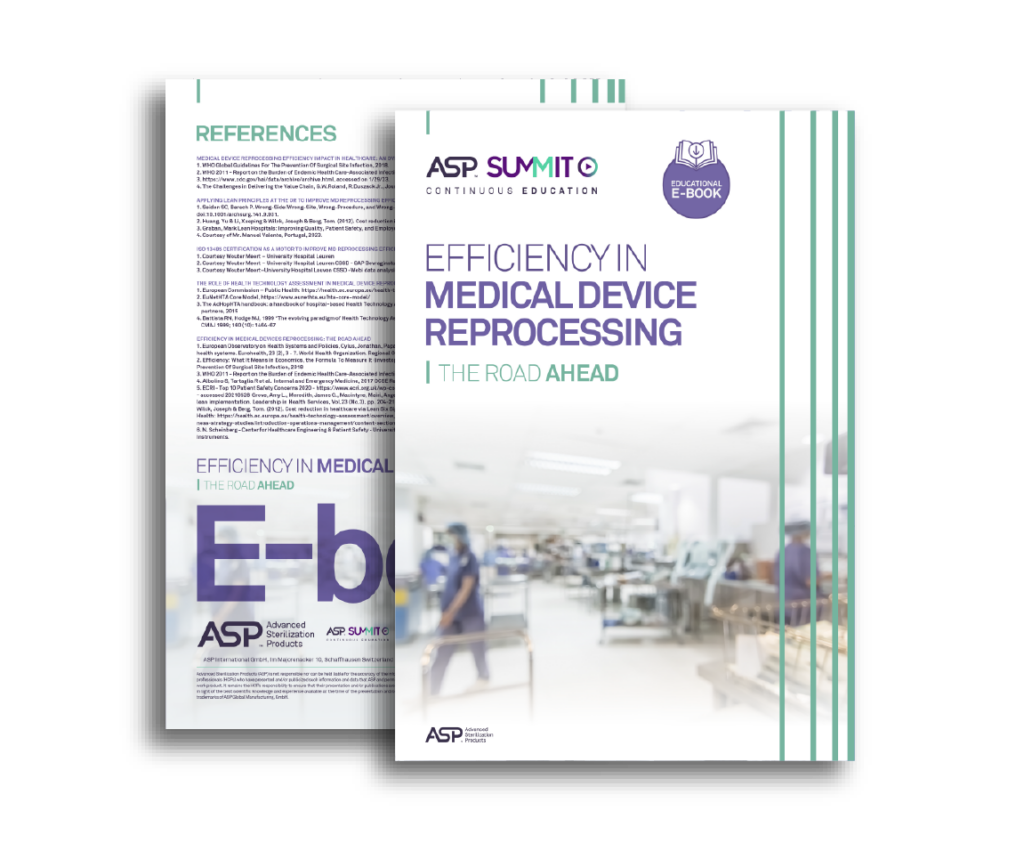
Efficiency in Medical Device Reprocessing: The Road Ahead
Create a free account to access all information→Efficiency in healthcare means delivering safe, high-quality, cost-effective care while minimizing waste — a growing imperative as budgets tighten and environmental concerns mount.¹ Medical device (MD) reprocessing is central to this goal: proper reprocessing prevents healthcare-associated infections (HAIs), which impose major clinical and financial burdens worldwide,² and enables the value chain connecting hospitals, staff, and patients.³
Applying Lean principles in the operating room can cut costs by 30–40% while reducing preventable errors — an estimated 1,300–2,700 wrong-site or wrong-procedure surgeries occur annually.⁴ Lean Six Sigma methodologies further streamline instrument processing to eliminate waste and improve patient safety.⁵,⁶
ISO 13485 certification drives efficiency in Central Sterile Services Departments (CSSDs) by enabling data-driven process analysis, risk management, and continuous improvement, as demonstrated at University Hospital Leuven.⁷ Emerging technologies — AI, robotics, and RFID — support this by reducing human error and improving traceability, provided they remain economically balanced.
Finally, Health Technology Assessment (HTA) offers a systematic, evidence-based framework spanning safety, effectiveness, and economic dimensions, bridging knowledge and policy decisions to guide reprocessing investments.⁸,⁹,¹⁰
Together, these strategies position MD reprocessing as a cornerstone of sustainable, high-value healthcare systems.
Inside the eBook, you’ll learn about:
- The impact of medical device reprocessing efficiency on healthcare systems, including its role in preventing healthcare-associated and surgical site infections
- How Lean principles applied in the operating room reduce waste, cost, and error
- How ISO 13485 certification and data-driven risk management improve CSSD performance
- The role of Health Technology Assessment (HTA) in guiding reprocessing decisions
- How AI, automation, and RFID technologies are reshaping sterile processing
- The connection between MD reprocessing, circular economy principles, and value-based healthcare
Reasons to download the eBook
- Get practical, expert-led strategies for improving efficiency across the full MD reprocessing cycle
- Learn from real case studies, including data-management practices at University Hospital Leuven
- Understand how Lean, ISO 13485, and HTA frameworks work together rather than in isolation
- Stay ahead of emerging technology trends (AI, robotics, RFID) shaping the future of sterile processing
- Access takeaways distilled from a four-part expert webinar series, summarized in one resource
Authors





Related eBooks

References
- European Observatory on Health Systems and Policies, Cylus, J., Papanicolas, I., & Smith, P.C. (2017). Identifying the causes of inefficiencies in health systems. Eurohealth, 23(2), 3–7. World Health Organization, Regional Office for Europe.
- WHO (2011). Report on the Burden of Endemic Health Care-Associated Infection Worldwide.
- Roland, G.W., & Duszak, R. Jr. (2015). The Challenges in Delivering the Value Chain. Journal of the American College of Radiology, 12(4), 409–411.
- Seiden, S.C., & Barach, P. (2006). Wrong-Side/Wrong-Site, Wrong-Procedure, and Wrong-Patient Adverse Events: Are They Preventable? Arch Surg, 141(9), 931–939.
- Huang, Y., Li, X., Wilck, J., & Berg, T. (2012). Cost reduction in healthcare via Lean Six Sigma. 62nd IIE Annual Conference and Expo 2012.
- Graban, M. (2018). Lean Hospitals: Improving Quality, Patient Safety, and Employee Engagement (3rd ed.).
- Courtesy of Wouter Meert, University Hospital Leuven (CSSD data management practices).
- European Commission – Public Health: Health Technology Assessment overview.
- EuNetHTA Core Model.
- Battista, R.N., & Hodge, M.J. (1999). The evolving paradigm of Health Technology Assessment: reflections for the millennium. CMAJ, 160(10), 1464–67.