- /
- ASP Summit
- /
- Shine on Flexible Endoscope Reprocessing
- /
- Improving Flexible Endoscope Reprocessing: the...
Shine On
Flexibel Endoscope Reprocessing
 Factsheet
 Podcast
 Recording
 Credits
This webinar addresses the challenge of endoscope-transmitted infections, emphasizing the critical role of inadequate drying as a major contributing factor. After introducing the issue and key risk factors, drying will be highlighted as the central focus. Evidence from the literature shows that residual fluid is frequently detected in endoscope channels upon inspection, emphasizing the importance of routine evaluation of clinically used flexible endoscopes. The prevalence of inadequate drying will be discussed, along with contributing practices such as Simethicone use and suboptimal reprocessing practices. Various drying methods—including drying cabinets, automated systems, and manual approaches—will be compared, outlining their respective advantages and disadvantages while highlighting strategies to reduce human error and improve patient safety.
Finally, the session will consider the practical demands of endoscope inspection and introduce the emerging role of AI-assisted inspection, supported by pilot data and demonstration videos.


Concise overview addressing the issue of infection transmission via endoscopes, followed by a visual representation highlighting the key contributing factors, including the role of drying.
A specific emphasis will be placed on drying as the focal point of this session. Review of specific infections that can result from inadequate drying and their consequences.

We will review existing literature that has documented the presence of residual fluid in the working channels of endoscopes in real world settings through inspection techniques.
Emphasize importance of directly visualizing the endoscope working channel to identify residual fluid and other potential hazards that could contribute to infection transmission.
Discuss role of Simethicone in interfering with endoscope drying.

Review literature demonstrating approaches for effective drying (automated drying, drying cabinets), along with advantages and disadvantages of each approach.

Will discuss the demands of flexible endoscope inspection of clinically used endoscopes (time, equipment) and introduce the role for AI in the process, along with some pilot data and videos of the process.
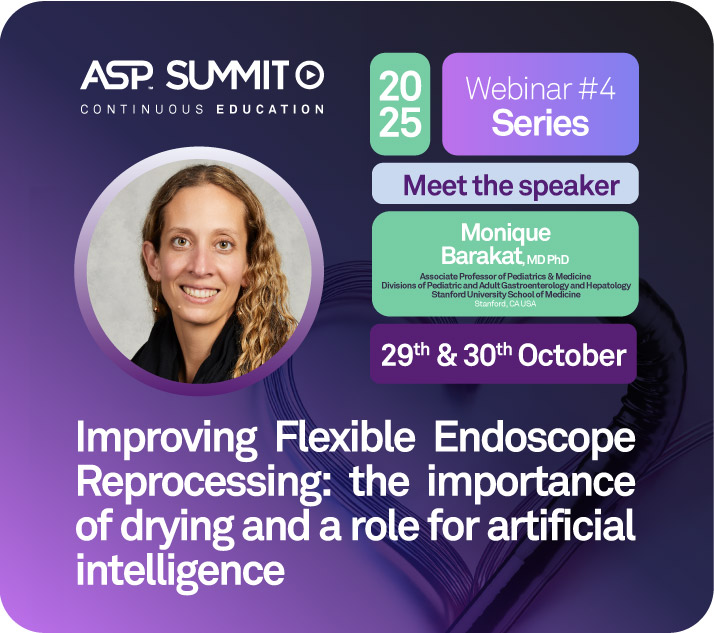
This is the fourth webinar dedicated to “Improving Flexible Endoscope Reprocessing: the importance of drying and a role for artificial intelligence”, presented by ASP Continuous Education.
29 & 30 October 2025

Associate Professor of Pediatrics & Medicine Divisions of Pediatric and Adult Gastroenterology and Hepatology
- Academic interventional endoscopist with research on improving endoscopic outcomes across the lifespan.
- Focuses on endoscopy-transmitted infections, endoscope reprocessing, and AI applications in reprocessing.
- Authored 100+ peer-reviewed publications, many in high-impact journals.
- Committed mentor for students, residents, and fellows; frequent invited speaker at national and international conferences.
- Associate Editor for Gastrointestinal Endoscopy, leading the Perspectives section.

To streamline this process of endoscope working channel inspections and enhance accuracy, the integration of artificial intelligence (AI) is emerging as a promising solution, offering the potential to automate and improve inspection efficiency.
- Endoscope-transmitted infections (ETIs) pose a significant threat to patient safety, necessitating stringent infection control measures to prevent severe health complications.
- Complete drying of endoscopes is essential to prevent microbial growth and biofilm formation, thereby reducing the risk of endoscope-transmitted infections (ETIs).
- Inspections have consistently shown that inadequate drying of endoscopes significantly increases the risk of endoscope-transmitted infections, highlighting the need for improved drying protocols.
- Implementing evidence-based drying approaches, such as automated drying systems and regular monitoring, is crucial for ensuring optimal drying outcomes and minimizing the risk of ETIs.
- The integration of artificial intelligence (AI) in endoscope inspections offers a promising solution to enhance efficiency and accuracy, addressing the significant demands of the inspection process.
Continuous educational credits
How to Earn Your CE Credits
During the process you will be redirected to Learning Management System (LMS) platform to complete your learning journey, which includes viewing the webinar and reviewing the factsheet.
Upon completion, you will receive your CE credit certificate.
How to navigate on LMS
We’ve improved the overall experience for our E-modules making them more engaging, easy to use and user-friendly. Watch the video.
 Webinar
Credits