SYMPOSIUM PAGE
Register to be among the first healthcare professionals to get access to the symposium recording and assets
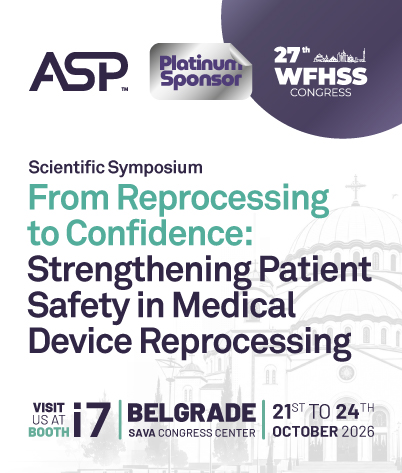
Sava Congress Center
Belgrade, Serbia
SYMPOSIUM PAGE
Register to be among the first healthcare professionals to get access to the symposium recording and assets
Sava Congress Center
Belgrade, Serbia

This symposium have simultaneous translation in 16 languages.
To access this service please bring your mobile device and headphones
Join us for this insightful symposium where we will tackle the challenges in medical device reprocessing and improve patient safety!

GENERAL ANNOUNCEMENT
The growing use of reusable invasive medical devices (RIMDs), flexible endoscopes, robotic systems, and other complex surgical technologies has increased the importance of effective medical device reprocessing to ensure patient safety and device performance. Proper cleaning, disinfection, and sterilization remain essential components of infection prevention programs and play a critical role in reducing the risk of microbial transmission. Effective reprocessing depends on validated procedures, trained personnel, quality management, and monitoring across the reprocessing cycle.¹⁻⁵
Among the challenges faced by healthcare facilities, biofilm formation remains a significant concern. Biofilms are complex communities of microorganisms enclosed within a protective extracellular matrix that can develop on reusable medical devices when residual soil, retained moisture, device complexity, or delays in reprocessing are present. As biofilms mature, they generally become more difficult to remove and may demonstrate increased tolerance to cleaning and disinfection processes.⁶⁻⁹
The adoption of minimally invasive procedures and advanced endoscopic interventions has increased reliance on devices with narrow lumens, internal channels, moving components, and other design features that can complicate inspection and cleaning. These challenges have increased interest in understanding contamination risks, improving cleaning verification practices, and implementing evidence-based contamination prevention strategies.²,³,¹⁰⁻¹²
Scientific literature and outbreak investigations have shown that contamination has been detected in patient-ready devices, including devices reportedly reprocessed according to established guidance. Reports involving flexible endoscopes and other reusable medical devices have highlighted the importance of evaluating reprocessing effectiveness, understanding contamination pathways, and continuously improving quality systems designed to reduce infection transmission risks.²,³,¹³⁻¹⁶,²⁵,²⁶
As a result, healthcare professionals are evaluating whether compliance with established requirements alone is sufficient to consistently achieve the intended reprocessing outcome. Increasing attention is being directed toward validation science, workflow reliability, contamination monitoring, human factors, and risk-management principles that can strengthen confidence in reprocessing performance. Evidence on endoscope reprocessing and response to process failures underscores the importance of process control, staff competency, risk assessment, and continuous improvement across reprocessing workflows.¹⁷⁻²⁰,²⁵,²⁷
Effective reprocessing programs must also operate within broader healthcare priorities that include staff safety, operational efficiency, sustainability, equipment preservation, and responsible resource utilization. Healthcare leaders continue to evaluate technologies and workflows that support patient safety, operational efficiency, and sustainability while meeting regulatory requirements and addressing environmental considerations.²¹⁻²⁴
During the ASP Symposium, attendees will examine the current scientific understanding of biofilm formation, persistence, and control in reusable medical devices and flexible endoscopes. Discussions will examine factors associated with device contamination, review evidence supporting anti-biofilm strategies, and consider practical approaches to improving reprocessing performance. The symposium will also explore how margin-of-safety principles can be applied throughout the reprocessing workflow to strengthen confidence in device readiness, staff protection, and patient safety.
These topics will highlight the role of risk assessment, validation science, workflow reliability, and continuous quality improvement in medical device reprocessing. Achieving reliable reprocessing outcomes requires a systems-based approach that integrates validated procedures, staff competency, quality monitoring, response to process failures, and continuous improvement. The goal is to help healthcare facilities strengthen reprocessing practices, improve confidence in reprocessing outcomes, and support safe patient care.¹⁷⁻²⁰, ²⁵⁻²⁷
SPEAKERS


- Vice President of the World Federation of Hospital Sterilization Sciences and SSD Manager at NSW Health.
- Over two decades of dedicated service in the hospital sector, with a focus on advancing sterilization and infection control practices for the past decade.
- His expertise includes management, strategic planning, clinical education, research, and SSD department development and design in healthcare settings.
- Commitment to excellence in sterilization and infection control education – Vice President and Scientific Officer for the World Federation for Hospital Sterilization Sciences, and past President of the Federal Sterilizing Research and Advisory Council of Australia.
- Collaboration with the World Health Organization in the Asia-Pacific Region to improve local and international standards.
- Australian Certification in sterilization Teacher & passionate about empowering leadership and driving innovation & excellence in healthcare sterilization and infection control.

- Trust Decontamination Lead for Manchester University Hospitals NHS Foundation Trust, the largest Healthcare provider in Northern Europe, 10 Acute care hospitals, 7 community medical centres. 30,000 staff and over £3 billion turnover.
- A Director & Chairman for the Institute of Decontamination Sciences the UKs largest professional body for Decontamination.
- Registered Healthcare Scientist specialising in Decontamination and Infection Prevention and Control.
- Published in 2012 for research conducted with Public Health England, looking at cleaning efficacy of chemistries on TSE (CJD) Prions.
- Over 17 years’ experience in Decontamination Science, being one of the first in the UK to centralise Endoscope decontamination and have processes accredited to ISO13485 and MDR back in 2009.
- Currently conducting extensive research into biofilms with a view to challenge international standards and guidance documents, particularly for Flexible Endoscope Decontamination.
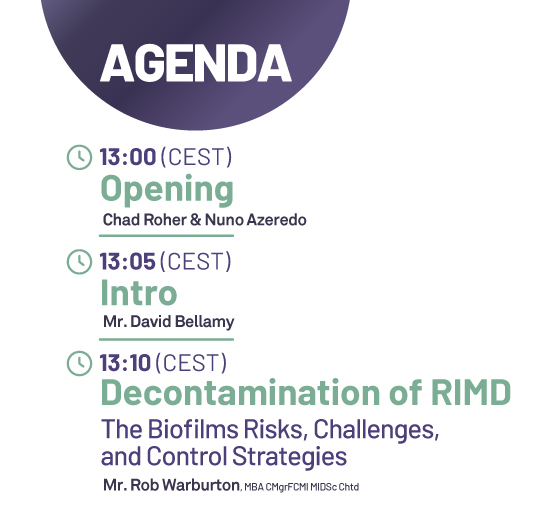
Biofilm remains one of the greatest challenges in medical device reprocessing. This presentation explores how biofilms form, persist and resist cleaning and disinfection processes. It will examine the risks posed to reusable surgical devices and flexible endoscopes, review the clinical implications of contamination, and discuss current and emerging anti-biofilm strategies. The session will provide practical insights to support safer reprocessing and improved patient outcomes

- Chief Medical & Scientific Officer at Advanced Sterilization Products (ASP), focused on reducing Hospital Associated Infections and improving standards of care.
- Holds an M.D. in Perioperative Medicine and Surgical Critical Care from the Mount Sinai School of Medicine.
- Earned B.S. and M.S. degrees in Chemical Engineering from Columbia University, and an M.B.A. from the MIT Sloan School of Management.
- Former faculty member at the University of Pennsylvania School of Medicine with 10 years of clinical critical care experience.
- Author of 76 peer-reviewed publications and recipient of multiple research grants, including NIH-funded surgical research.
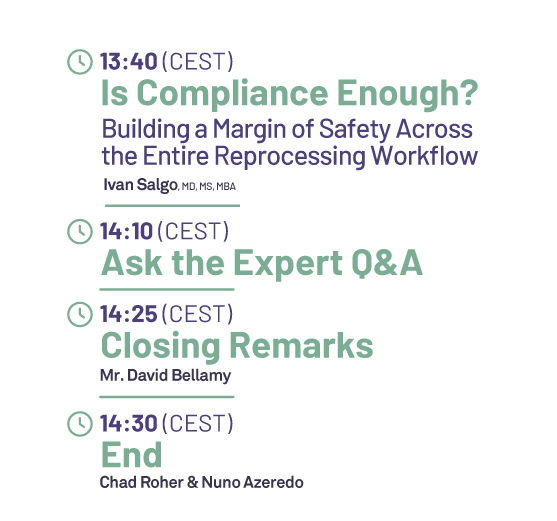
Regulatory and standards frameworks are critical in creating a safe foundation for the CSSD. This talk examines how to be ready for the unexpected, because it is unexpected or undetected events that typically cause problems once minimum frameworks are resourced.
Despite broad adherence to manufacturer instructions, biofilm formation, residual contamination, and endoscope-related infection risk remain persistent concerns, and current literature demonstrates that contamination events persist. This session explains why reprocessing programs should be built around a margin of safety rather than minimum requirements.
The discussion begins with the current evidence on contamination and biofilm, then explores how to critically evaluate claims made about devices, technologies, and reprocessing practices. A foundation in scientific principles will be stressed.
The session then moves to staff safety, reviewing the medical literature on environmental chemical exposure. Acute chemical exposures may be easy or difficult to recognize; repeated cumulative exposures are harder to detect and often overlooked. Real-time emissions monitoring offers visibility that periodic compliance testing cannot. Fugitive emissions and compliance with evolving international standards will also be reviewed.
The goal is straightforward: move beyond checking boxes and build a reprocessing workflow that provides a meaningful margin of safety for patients, staff, and technology.
Speaker Content Disclaimer:
The information, opinions, interpretations and recommendations presented on this page are provided by the individual speaker in their own capacity and do not necessarily reflect, nor should they be interpreted as reflecting, the views, policies, positions or endorsements of Advanced Sterilization Products (ASP). The speaker retains responsibility for the content, references and scientific substantiation provided. This content is made available for educational and scientific information purposes only, is not intended as medical advice or as a product claim, and does not replace the applicable instructions for use, labelling or applicable national requirements.
Here are the symposium’s assets
You can download the ebook, watch the symposium’s recording, or listen to the posdcast. Register for free to access.



- World Health Organization. Global Guidelines for the Prevention of Surgical Site Infection. 2nd ed. Geneva, Switzerland: WHO; 2018.
- Ofstead CL, Buro BL, Hopkins KM, Eiland JE, Wetzler HP, Lichtenstein DR. Duodenoscope-associated infection prevention: A call for evidence-based decision making. Endoscopy International Open. 2020;8:E1769-E1781.
- Kovaleva J, Peters FTM, van der Mei HC, Degener JE. Transmission of infection by flexible gastrointestinal endoscopy and bronchoscopy. Clinical Microbiology Reviews. 2013;26(2):231-254.
- Dancer SJ, Stewart M, Coulombe C, Gregori A, Virdi M. Surgical site infections linked to contaminated surgical instruments. Journal of Hospital Infection. 2012;81(4):231-238.
- Southworth PM. Infections and exposures associated with unsuccessful decontamination of reusable surgical instruments. Journal of Hospital Infection. 2014;88(3):127-131.
- Hall-Stoodley L, Costerton JW, Stoodley P. Bacterial biofilms: From the natural environment to infectious diseases. Nature Reviews Microbiology. 2004;2(2):95-108.
- Percival SL, Suleman L, Vuotto C, Donelli G. Healthcare-associated infections, medical devices and biofilms: Risk, tolerance and control. Journal of Medical Microbiology. 2015;64(4):323-334.
- Donlan RM. Biofilms and device-associated infections. Emerging Infectious Diseases. 2001;7(2):277-281.
- Flemming HC, Wingender J. The biofilm matrix. Nature Reviews Microbiology. 2010;8(9):623-633.
- Rutala WA, Weber DJ. New developments in reprocessing semicritical items. American Journal of Infection Control. 2013;41(Suppl):S60-S66.
- U.S. Food and Drug Administration. Reprocessing Medical Devices in Health Care Settings: Validation Methods and Labeling. Guidance for Industry and FDA Staff. Silver Spring, MD; 2015.
- Rutala WA, Weber DJ. Guideline for Disinfection and Sterilization in Healthcare Facilities. Centers for Disease Control and Prevention; Updated 2019.
- Ofstead CL, Quick MR, Eiland JE, Adams SJ. Effectiveness of reprocessing for flexible bronchoscopes and endobronchial ultrasound bronchoscopes. Chest. 2018;154(5):1024-1034.
- Ofstead CL, Heymann OL, Quick MR, et al. The effectiveness of sterilization for flexible ureteroscopes: A real-world study. American Journal of Infection Control. 2017;45(8):888-895.
- U.S. Food and Drug Administration. Infections Associated with Reprocessed Flexible Bronchoscopes: Safety Communication. Reprocessing of Reusable Medical Devices | FDA
- U.S. Food and Drug Administration. Update: Change in Reprocessing Methods with Certain Karl Storz Urological Endoscopes. 2022. Reprocessing methods for Karl Storz urological endoscopes
- Rutala WA, Weber DJ. Reprocessing semicritical items: An overview and an update on the shift from high-level disinfection to sterilization for endoscopes. American Journal of Infection Control. 2023;51(Suppl 11):A96-A106.
- Ofstead CL, Wetzler HP, Snyder AK, Horton RA. Endoscope reprocessing methods: A prospective study on the impact of human factors and automation. Gastroenterology Nursing. 2010;33(4):304-311.
- Rutala WA, Weber DJ. How to assess risk of disease transmission to patients when there is a failure to follow recommended disinfection and sterilization guidelines. Infection Control & Hospital Epidemiology. 2007;28(2):146-155.
- Segarra GC, Lusk C, Catchpole K, et al. Patient safety incident reporting in sterile processing: A systems perspective. Proceedings of the Human Factors and Ergonomics Society Annual Meeting. 2022;66(1):1-5.
- Pichler PP, Jaccard IS, Weisz U, Weisz H. International comparison of health care carbon footprints. Environmental Research Letters. 2019;14(6):064004.
- Health Care Without Harm. Healthcare’s Climate Footprint. 2019.
- Kane GM, Bakker CA, Balkenende AR. Towards design strategies for circular medical products. Resources, Conservation and Recycling. 2018;135:38-47.
- McCreanor V, Graves N. An economic analysis of the benefits of sterilizing medical instruments in low-temperature systems instead of steam. American Journal of Infection Control. 2017;45(7):756-760.
- Ofstead, C. L., Smart, A. G., & Lamb, L. A. (2026). Effectiveness of endoscope processing: An update. American journal of infection control, 54(9S), S70–S78. https://doi.org/10.1016/j.ajic.2026.02.006
- Liu, M., Zu, Q., Zheng, L., Wen, L., Li, S., Nie, Y., Chen, F., & Zhang, Q. (2026). Investigation of microbiological non-compliance of endoscopic final rinse water associated with opportunistic premise plumbing pathogens contamination in connecting tube. Scientific Reports, 16, Article 10783. https://doi.org/10.1038/s41598-026-10783
- World Federation for Hospital Sterilisation Sciences. (n.d.). Quality management. WFHSS Guidelines. https://guidelines.wfhss.com/frontpage/quality-management/